
Introduction
The 19th-century architect and historian Eugène Emmanuel Viollet-le-Duc (1814–1879) was one of the leading figures of the Gothic Revival in France. Best known for his restorations of the Sainte-Chapelle, Notre Dame de Paris, and the fortified city of Carcassonne, he was also a prolific scholar. His six-volume Dictionnaire Raisonné du Mobilier Français (1873) remains one of the most influential illustrated encyclopedias of medieval French life, covering clothing, arms, armor, furniture, and tools.
The images featured here are taken from Volume II of that work. They are in the public domain and provide rare visual evidence of woodworking tools used in the Middle Ages. While some details reflect Viollet-le-Duc’s own 19th-century interpretations, they remain valuable historical references for understanding the craft of medieval carpenters and joiners.
Selected Illustrations
A 13th-Century Carpenter
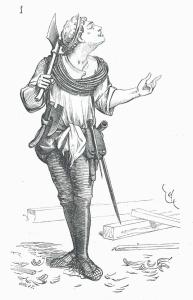
This composite image combines details from stained glass at Bourges Cathedral, tapestries at St. Medard in Paris, and manuscript marginalia from Oxford’s Bodleian Library. The carpenter is depicted carrying a broad axe over his shoulder, a smaller axe at his belt, and a folding rule tucked beneath his tool pouch. A compass rests at his side, while a bisaiguë (a long chisel-like tool used for cleaning mortises) is strapped at his belt, resembling a sword.
A Joiner at Work
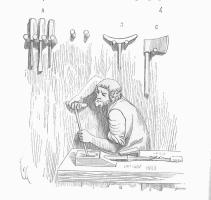
From the late 15th-century choir stalls of Montréale, this illustration shows a joiner using what appears to be an auger. Behind him, chisels, augers, and axes are neatly racked on the wall. His workpiece is secured to the bench with a holdfast, a tool still recognizable to woodworkers today.
Axes of the Middle Ages
Two manuscript sources (c. 1395 and c. 1450) depict the T-shaped carpenter’s axe, a form widely used from the time of the Bayeux Tapestry onward. These images confirm the continuity of axe design across centuries of European woodworking.
A Pair of Adzes
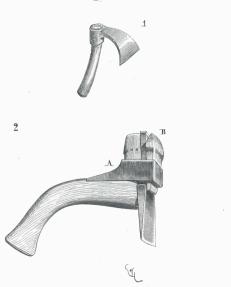
Among Viollet-le-Duc’s illustrations is a pair of medieval adzes. While not specifically sourced in the text, they closely match examples commonly seen in manuscript images and frescoes of the period — and remarkably, similar forms remain in use even today.
The lower tool is a strapped adze, modeled after an ancient Egyptian example preserved in the Louvre. This continuity of design highlights how effective the adze was across cultures and centuries. Comparable tools appear in medieval Italian frescoes, underscoring its widespread role in shaping timber throughout the Middle Ages.
Hatchets
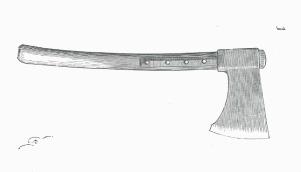
- A hatchet recovered at the castle of Pierrefonds (15th century) reflects common medieval forms.
- A carpenter’s hammer of typical 15th-century form is also depicted, matching examples unearthed in archaeological contexts.
The Plane
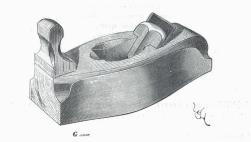
One of the most fascinating images comes from Albrecht Dürer’s engraving “Melancholia” (c. 1514). The small German-style smoothing plane is held together by side slots rather than a transverse pin — one of the earliest artistic depictions of this innovation. Archaeological finds, such as the 13th-century Bergen plane, confirm the development of this tool form in northern Europe.
The Frame Saw
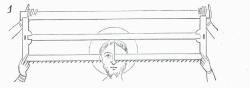
An illustration from a Carolingian manuscript (9th century) shows a standard frame saw. This is significant because the tool was long believed to have vanished from northern Europe until the 13th century. Viollet-le-Duc’s example suggests continuity of use much earlier than previously thought.
A Medieval Lathe
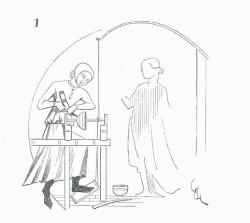
From a 13th-century manuscript in the Bibliothèque Nationale, this image depicts a pole lathe in use. The cord, wrapped around the mandrel and attached to a pole and treadle, demonstrates the reciprocating motion typical of medieval turning. This simple but effective design remained in use for centuries among turners across Europe.
Conclusion
Viollet-le-Duc’s Dictionnaire Raisonné du Mobilier Français provides not only a window into medieval life as imagined by a 19th-century scholar but also an invaluable record of tools and techniques known in the Middle Ages. While his reconstructions sometimes reflect the Gothic Revival spirit of his era, the illustrations of axes, adzes, chisels, planes, saws, and lathes remain essential references for historians and woodworkers alike.
By studying these images, we better understand the continuity of woodworking traditions that shaped Europe’s cathedrals, castles, and domestic interiors.